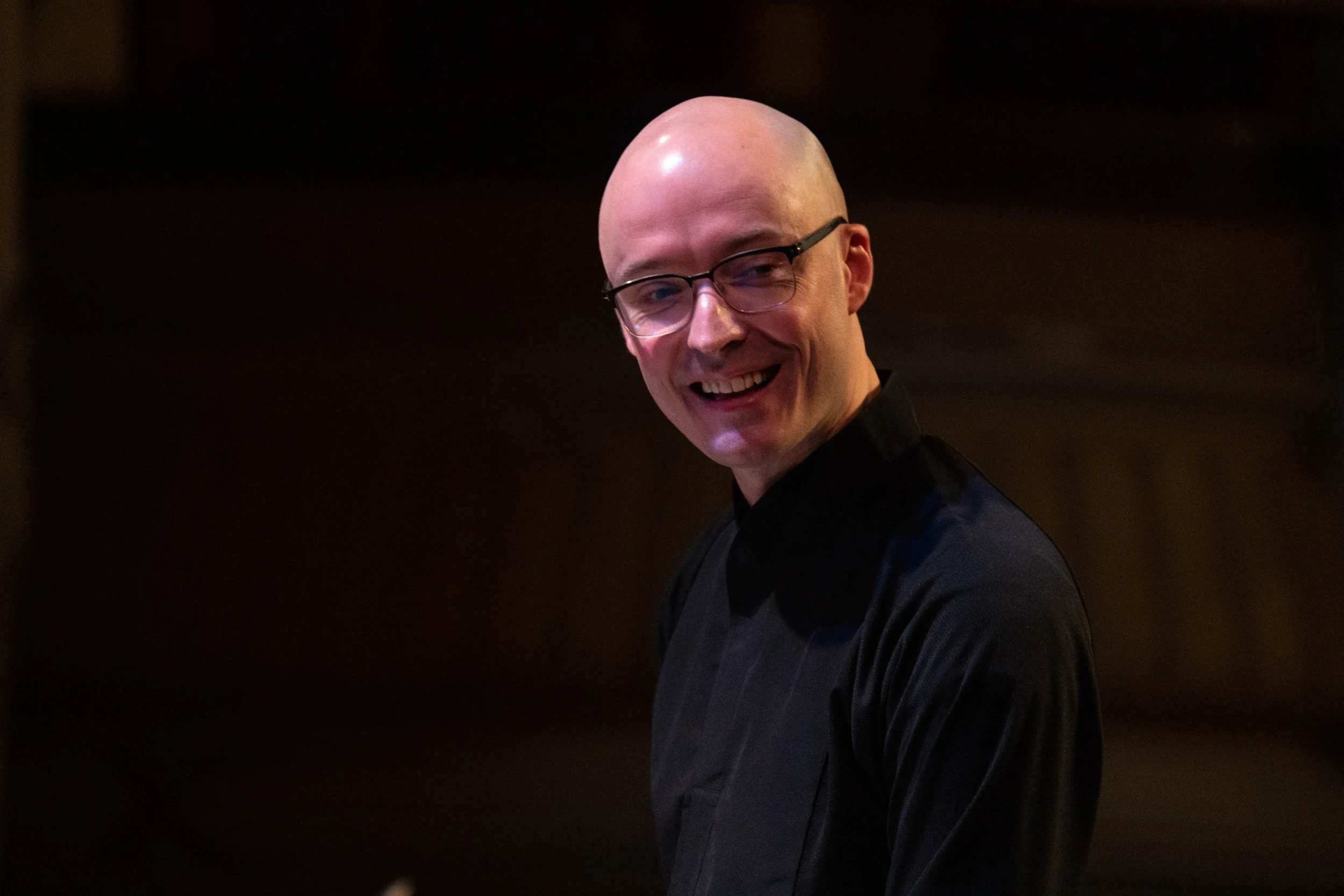
A farewell to Founder and Artistic Director Gregory Hughes
In 2010, a 24-year-old bassoonist reached out to Lakeside Pride, a consortium of LGBTQ+ music ensembles, about openings in their symphony orchestra. As it turned out, the group had been defunct since its last music director departed a few seasons prior.
Most would shrug and try their luck with another ensemble. Not Greg Hughes. The Kentucky-born musician briefly studied conducting in college, so he responded to Lakeside Pride with a counteroffer: What if he conducted the group?
Armed with a former roster and his own network, Hughes set to work rebuilding the orchestra. In 2013, he oversaw its transition into an independent ensemble, rebranding it as the Lakeview Orchestra. The rest, as they say, is history.
Over the next 13 years, Hughes built up Lakeview while juggling various day jobs, from working at the Macy’s on State Street to a stint at the nonprofit Human Rights Watch. Now, at 40, he’s stepping away from the ensemble he founded to pursue his current calling as the executive director of the Elmhurst Symphony Orchestra.
Hughes leads Lakeview in his swan-song concert this Sunday at the Athenaeum Center for Thought & Culture. The following conversation has been edited for length and clarity.
Tell us about the orchestra’s early days. What were your ambitions for the group back then? For yourself?
We were kind of a reading orchestra. We'd do concerts, but we mostly wanted to have the experience of exploring repertoire. The first season or two, we did seven concerts. We did Tchaikovsky's Fifth Symphony with, like, three cellos. We had no business doing that music with that small an orchestra, but that wasn't the point. For a lot of us, after we got out of college, where else were we going to have the opportunity to play stuff like this?
We've been a pretty ambitious group from the get-go. By our standards of playing now, we sounded terrible, but we built our chops very quickly as a group.
When I was 24, I was still figuring out what I wanted to be when I grew up. At the time, I thought, “Well, maybe this will spin off into a conducting career. Who knows?” It actually led into professional admin work, which I find I rather enjoy.
Funnily enough, the creation of Lakeview in 2013 also coincided with a couple of things in my personal and professional life that opened some doors. I met my now-husband in March of 2013, and we moved in together later that year. That gave me a new sense of domestic and financial security that enabled me to change jobs. I started my nonprofit career at Chicago Shakespeare Theater and got the fundraising, administrative, and marketing experience in my nine-to-five that allowed me to partner with [Lakeview Orchestra president and associate concertmaster] Charles Palys on a massive capital campaign. That, in turn, allowed Lakeview to relocate from Nettelhorst [Elementary School, the orchestra’s former venue] to the Athenaeum. Before then, I didn't have the skillset to even know how to tackle something like that.
What are some Lakeview concerts that stand out as special milestones — moments when you could really appreciate how far the group had come?
The difference between the first time we played Mahler 1 and the second time, which was seven years later. The orchestra basically read [the symphony] in the first rehearsal at a comparable quality to what we’d performed in the concert seven years before. It was a night-and-day difference.
The piece that stands out to me as an “OK, I think we're making progress” moment was Prokofiev 5. In our fifth season, we programmed all fifth symphonies, and we played it that February. I felt like we nailed the beginning and kept that through-line. It wasn't the most solid performance we've ever had, but we unlocked that ability, for the first time, to really deliver an entire piece of music with an intentionality and focus. That fifth season, the 2017/18 season, was our last at Nettelhorst, and that was an impetus for us to find a big-boy hall.
Talk to us about the repertoire for your final concert: Shostakovich’s Ninth and Beethoven’s Eroica.
I’m a bassoonist, and I love the instrument. Shostakovich 9 has a hauntingly beautiful solo that I remember hearing live with the Cincinnati Symphony when I was in high school. I had a huge bassoonist crush on the principal bassoonist, Bill Winstead, and I also had a huge conductor crush on Paavo Järvi, who was the music director in Cincinnati at the time. He’s still one of my favorite living conductors. This bassoon solo was stuck in my craw from an early age. Later, I had to learn the solo and play it in excerpts and for auditions.
But the real reason I programmed this concert the way I did? I'll cop to it: It's a personal political statement. I have never really pulled that lever with Lakeview before, for lots of reasons. It’s not necessarily appropriate, especially given the complexities of nonprofit regulations. But art can, should, and does speak truth to power. I wanted to make that point on my way out the door, [given] the programmatic similarities of the two pieces.
I will always have a tiny twinge of regret that we never got to do Beethoven 9 together. Next to that, I think Beethoven 3 is his best [symphony]. It's the most historically significant Beethoven, and we had never done Beethoven 3 before. In keeping with our reading-orchestra roots, I thought we needed to do something we've never done before for our last concert together, as well.
Tell us about your role at the Elmhurst Symphony, and how Lakeview prepared you for that chapter.
The Elmhurst Symphony is similar to Lakeview in that they have a lot of volunteer musicians, but several players in key roles are paid. It's kind of a hybrid, which was a nice stepping stone: I can bring my fundraising experience, but I'm learning the ins and outs of like contracting union musicians and that whole world of production. I’ve really enjoyed it — I'm obviously not conducting there at all, but as an administrator who's, in theory, more behind the scenes, I can actually steer an organization in interesting ways.
I've taken pride in numbers a lot. I reversed a pretty substantial deficit in my first couple years, and now we're basically operating in the black, or pretty close to it, every year. I feel like I've done a lot to improve the financial sustainability of the orchestra, and that's paying dividends artistically.
I don't know what my next move is. I don't have plans to move on anytime soon. In fact, I want to take the next couple of years to really focus on Elmhurst and put more of myself into that role. Maybe I'll be there for 15 years, like I was with Lakeview, or maybe I'll get an itch and go somewhere else. We'll see.